Okta Support System Breach and Tenant Token Exposure
Session tokens buried in support files gave attackers administrator access within thirty minutes.

Summary
Session tokens buried in support files gave attackers administrator access within thirty minutes.
The Okta breach of 2023 did not compromise Okta's identity platform. It compromised the support case management system sitting next to it, where an attacker used stolen credentials to get in and found something more useful than a password: live session tokens sitting inside customer-uploaded troubleshooting files. Production identity infrastructure stayed intact for the entire incident. The distinction matters because everything that follows, the speed of the exploit, the containment differences across customers, the governance failure, only makes sense once the attack surface is correctly located.
Okta's Core Identity Product Was Not the Attack Surface
If you treat the breach as a failure of Okta's identity engine, the lesson gets lost. The attacker did not break multi-factor authentication, did not forge a token, and did not find a flaw in how Okta verifies who someone claims to be. The attacker got into the support case management system using stolen credentials, a system that was built to help engineers fix customer login problems, not to hold authentication material. What was waiting inside wasn't a vault of passwords or private keys. It was HAR (HTTP Archive) files, the browser exports customers upload so a support engineer can see what went wrong during a failed login.
That detail reframes the entire incident. A session token pulled from a HAR file gives an attacker the same access as the administrator who generated it, with no login screen, no password prompt, and no multi-factor check standing in the way. MFA didn't fail here. It simply never got a chance to matter, because the tokens an attacker found were already proof that authentication had happened. The session MFA was meant to protect had already been granted. Calling this an identity platform breach blames the lock for a key left on the porch.
HAR files as credential-equivalent material in the support workflow
HAR files exist because troubleshooting a login error from the outside is close to impossible without seeing what the browser actually sent and received. They record every request, every response, every header, every cookie passed during a session. A support engineer can use one to reproduce a problem, and an attacker can use the same file to replay somebody else's session. The format's strength as a diagnostic tool is the same property that turns it into a loaded weapon in the wrong hands: it doesn't summarize a session, it reproduces it.
Customers uploading these exports to Okta support tickets had no reason to think they were handing over active credentials. Browsers generate HAR files through a standard export function, and nothing in that export flags the session tokens riding along inside it. The burden of noticing and stripping that material sat entirely on the person filing the ticket, and the upload workflow offered no automated redaction to catch what they missed. Okta's own October 20 advisory states that the company worked with impacted customers to investigate, revoked session tokens embedded in shared HAR files, and only then began advising customers to sanitize HAR files before sending them. Advice that arrives after the breach confirms the control wasn't there before it. Cloudflare took a different route and built a fix instead of a warning: its HAR Sanitizer tool strips session cookies and JSON Web Tokens from any uploaded HAR file and was released free and open source, which proves automated redaction is a solvable engineering problem, not a theoretical one, even if no sanitizer catches every possible credential format. The artifact, not the stolen password, was the real identity material in this incident. Securing the password while leaving the artifact exposed closes the wrong door.
The attack timeline and the 30-minute window of unmonitored access
The lack of monitoring is visible in how fast the exploit moved. Once a customer uploaded a HAR file to the support platform, the attacker was accessing that customer's tenant within roughly 30 minutes. No system flagged the extraction of session tokens from an uploaded file as unusual. No system flagged the replay of that token into a live customer environment as unusual either. Thirty minutes is barely enough time to get coffee, and it was enough time here to go from a routine support upload to standing inside someone else's administrator session.
The playbook once inside followed a repeatable sequence. The attacker pulled session tokens out of the uploaded HAR file, then replayed them so they could access the corresponding tenant as the administrator who'd filed the original ticket. From there, the moves were built for staying power rather than smash-and-grab: activating dormant user accounts or creating new ones, then tampering with MFA settings by adding authenticators the attacker controlled. That last step is the one that outlives the stolen token. Even after the original session token expired, the attacker had planted a way back in. A 30-minute exploitation window paired with MFA tampering for persistence describes a support workflow that had no equivalent of the alarms, cameras, or motion sensors guarding the production identity path next door.
The 15-day notification gap that compounded the technical failure
Every incident response plan assumes a direction of information flow: the vendor detects the problem and tells the customer. Okta's escalation procedures were built on that assumption, and the assumption broke when BeyondTrust told Okta about the intrusion before Okta had found it independently. A customer became the one holding the flashlight, and the vendor's own process had no clean lane for that kind of signal to travel back in.
Okta's November root-cause advisory eventually landed on the same conclusion BeyondTrust had already reached on its own: the breach traced back to a stolen credential used to access the support case management system. The technical finding wasn't new information by the time Okta published it. What the gap between BeyondTrust's detection and Okta's confirmation reveals is that incident response built for a one-way relationship, vendor warns customer, has no good answer for the reverse case, and fifteen days is what that answer costs when it has to be improvised.
How BeyondTrust, 1Password, and Cloudflare experienced the breach differently
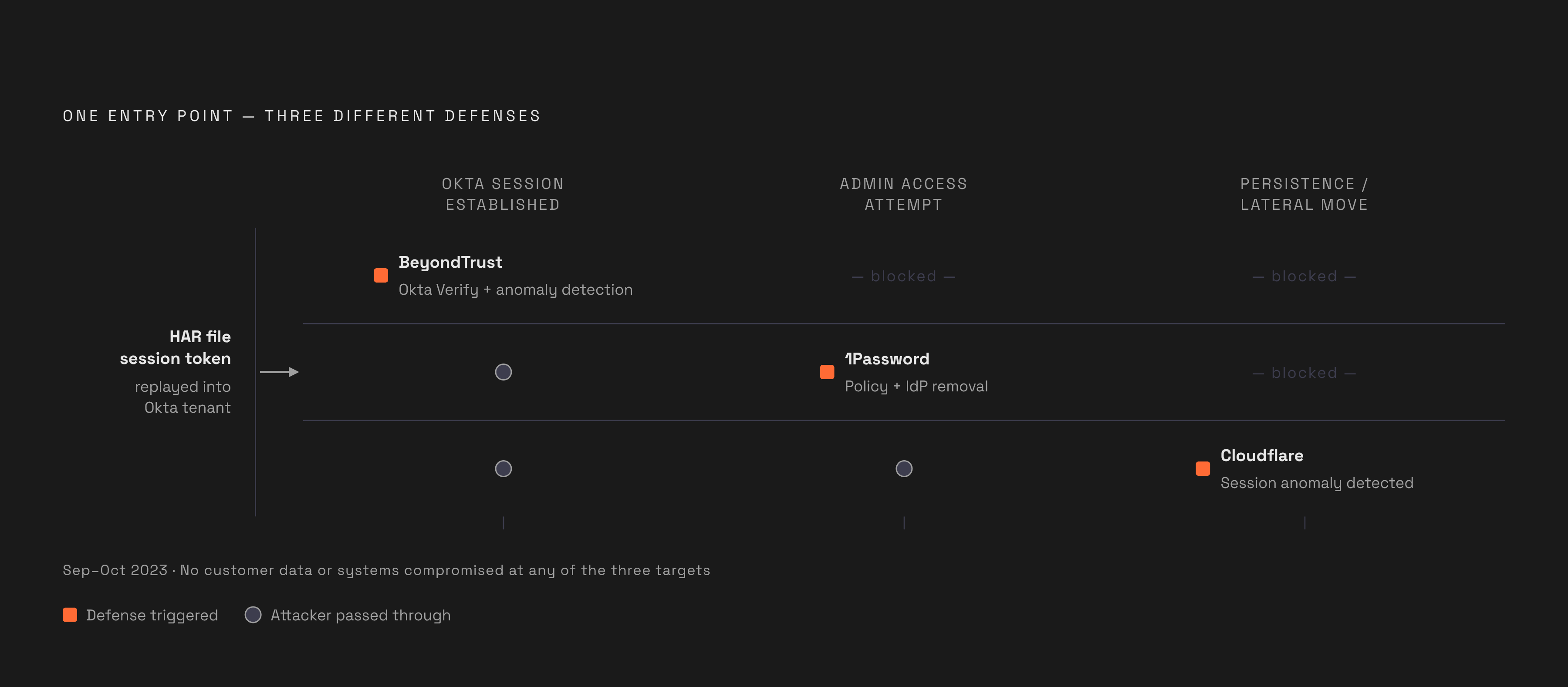
Three named customers, BeyondTrust, 1Password, and Cloudflare, sat on the receiving end of the identical attack path. Each walked away with a different outcome, and the difference had nothing to do with Okta's support platform. It came down to controls each organization had already built on its own side of the fence.
BeyondTrust caught the intrusion first, on September 28, 2023, the same day the HAR file hit the support platform. BeyondTrust required device verification through Okta Verify on a managed device on top of standard credentials, and that extra check blocked the attacker from reaching the admin console directly. The attacker adapted and pivoted to API-level actions instead, but BeyondTrust's Identity Security Insights tooling picked up the anomaly and shut it down before anything further developed. No BeyondTrust system was compromised, and no BeyondTrust customer was affected.
1Password's security team had policy controls in place that blocked several of the attacker's moves outright: an attempt to reach an IT team member's user dashboard, and a later attempt to log in through a Google identity provider that 1Password had already removed from use. A Malaysia-based IP address tied to the attack was linked to the BeyondTrust incident rather than to 1Password's own environment, a network-level signal that helped cut the session replay attempt short.
Cloudflare confirmed that the attacker hijacked a session token from a support ticket filed by a Cloudflare employee through Okta's support system, and it reported the unauthorized activity once it detected it. No Cloudflare customer data or systems were touched. Okta named Cloudflare as the fifth and final organization caught up in the incident.
Lining the three cases up reveals a pattern: identical entry point, three different stopping points, each one set by controls the customer had already built before the attacker ever showed up.
Shared Responsibility for the Exposure
The strongest objection to putting this on Okta's support workflow is straightforward: every affected customer, including 1Password, BeyondTrust, and Cloudflare, uploaded HAR files that still contained live session tokens. If the tokens are stripped before uploading, there is no exploitable artifact left to find. That argument holds up as far as it goes.
It just doesn't go far enough. It describes a mistake users made, not a workflow built to prevent that mistake. Okta's support platform had no automated sanitization step, no warning at the point of upload, and no default that limited how long an uploaded file stuck around. The entire control rested on one person remembering, at the exact moment of uploading a troubleshooting file under time pressure, to manually scrub session data out of it first. OWASP's Session Management Cheat Sheet and NIST's session management guidance both lay out a principle that long predates this incident: a session identifier can function as a temporary stand-in for the authentication that created it, so letting that identifier leak out is functionally the same as letting the credential leak out. This wasn't a hidden gotcha. It was the foundational logic session security has been built on for years, and a support platform built for an identity provider, one that routinely receives files carrying administrator-level session data, had every reason to treat that logic as a required workflow control, not a footnote in a help article.
Both things are true at once. Customers should have scrubbed their files before uploading, and the platform should have been built to catch what they didn't. The real fault line isn't between "customer error" and "vendor error." One system expects a human to remember a security step every single time under deadline pressure, and the other is engineered so that forgetting doesn't matter.
Governing a support workflow as identity infrastructure
The incident's real takeaway is a reclassification, not a scorecard. If a workflow regularly receives, stores, or moves authentication artifacts, it needs the same level of control as the production identity system, no matter what box it occupies on an org chart or a product diagram. A support ticketing tool doesn't look like identity infrastructure on paper. The moment it's holding a live session cookie, it is identity infrastructure, for as long as that cookie stays valid.
That has concrete implications. Access controls on a support platform need to match the strength of controls on the systems whose artifacts flow into it, so that means device verification, behavioral monitoring, and anomaly detection on who's opening which files. Upload workflows need automated sanitization wherever it's technically possible, clear warnings about what a HAR file actually contains, and instructions for rotating sessions after upload, and these need to be enforced steps, not a tip buried in documentation. Files shouldn't outlive the support case that required them. And access to those files needs logging as detailed as logging on production systems: who viewed it, from what IP, on what device, at what time, so that an anomalous access is visible inside the token's validity window instead of weeks after the damage is done. BeyondTrust's result is the proof this works: device verification plus real-time behavioral monitoring caught the attacker at the point of session replay, before persistence could take hold.
The same logic extends past human support engineers. AI agents built into enterprise environments that touch identity systems, file APIs, or support workflows pick up the exact same session-token and credential-artifact risks, but they operate at machine speed and without the pause that let a BeyondTrust analyst notice something was wrong and act on it. If you deploy an agent, runtime monitoring and enforceable limits on what it can access and transmit are the baseline requirement for running one safely.
The broader audit this incident invites isn't limited to support tickets. Email threads carrying session links, IT ticketing systems, logging pipelines, and developer debugging tools all carry the same structural risk: artifacts that function as authentication sitting in places built for convenience. The question every identity vendor and every enterprise customer now has to answer is which of those systems they're still treating as harmless paperwork.

