LastPass Breach and Encrypted Vault Exfiltration Chain
The breach wasn't a hack—it was a six-stage chain where each step unlocked the next.

Summary
The breach wasn't a hack—it was a six-stage chain where each step unlocked the next.
Most people remember the LastPass breach as a password manager getting hacked, a single event with a single cause and a single fix. That framing is wrong in a way that matters. The breach was a precisely chained sequence in which each stage unlocked the conditions for the next, and the attacker never broke the encryption at all. At least six distinct decision points existed where the chain could have been broken, and understanding each one changes what the breach actually teaches.
Stage one: compromising the development environment through a software engineer's corporate laptop
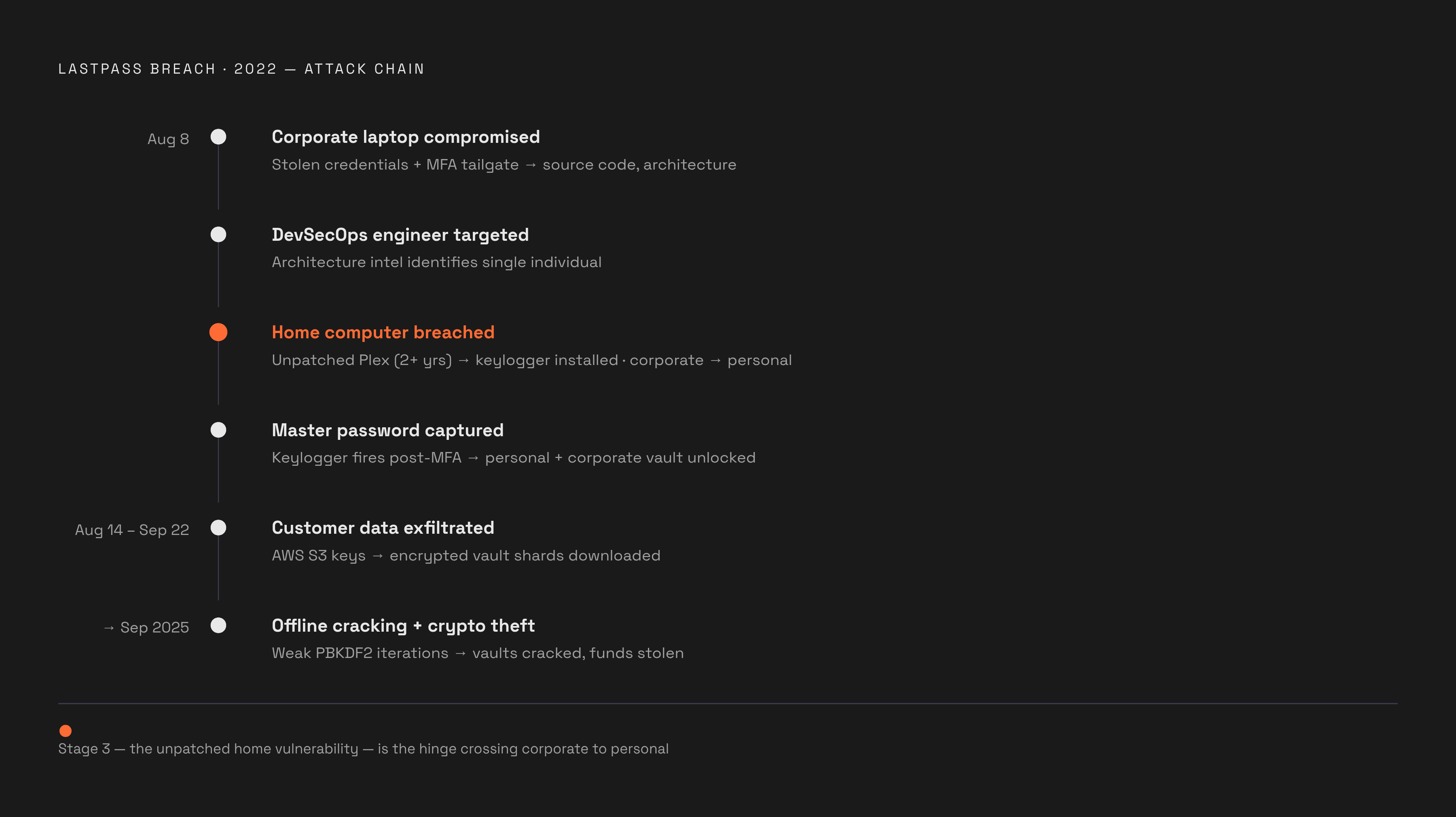
The chain began on August 8, 2022, with the compromise of a software engineer's corporate laptop. What the attacker gained was not just credentials but something more durable and more strategically valuable: a map of LastPass's production architecture. The attacker accessed a cloud-based development environment and exfiltrated source code, proprietary technical documentation, and internal system secrets. The Miami University case study identifies fourteen of approximately 200 source-code repositories as having been extracted. Among those repositories were cleartext embedded credentials, stored digital certificates for the development infrastructure, and encrypted credentials used for production.
The mechanics of entry were almost embarrassingly straightforward. The attacker used a third-party VPN to impersonate the software engineer, relying on stolen domain credentials and a successful MFA authentication. LastPass later described this as a "tailgate" approach, and no privilege escalation was required. The attacker simply presented valid credentials and walked through normally. This detail matters because it establishes the pattern that would repeat throughout the chain: the attacker never broke a control when they could instead present themselves as someone the control was designed to trust. The threat actor wiped logs and system artifacts, and an operating system upgrade already scheduled on the corporate laptop during those four days overwrote more, so the forensic evidence that might have revealed the full scope of what was taken is gone.
The timeline adds one more complication. LastPass was alerted to suspicious activity on August 12, three days after the initial compromise. By August 25 the company declared the first incident contained, and by September 15 it completed its investigation with no evidence of customer data access. The first incident, as it turned out, was the reconnaissance phase.
Stage two: using the first breach's intelligence to identify and target the right person
The technical documentation stolen in August transformed the attacker's position. Instead of probing LastPass's hardened corporate infrastructure, the attacker could now work with an insider's understanding of how the production environment was actually structured. That documentation revealed a critical fact: only a small number of DevSecOps engineers held the keys to the production cloud environment, and compromising one of them would be sufficient. Stage One's output was not credentials or data. It was a targeting dossier.
The attacker used it to pivot deliberately away from the better-defended perimeter. The new target was a single engineer's personal home computer, a machine outside LastPass's corporate security controls entirely. The vector was a vulnerability in a third-party media software package running on that home machine, which LastPass's disclosure describes as enabling remote code execution and the installation of keylogger software. The package has been widely identified as Plex Media Server, though LastPass never named it publicly. The vulnerability was more than two years old at the time of the attack, a patched flaw that had simply never been applied on the engineer's personal machine.
The second incident began August 12, 2022, and ran through October 26, 2022. That period overlapped almost entirely with the time LastPass believed the first incident was being investigated and contained. The attacker was not racing to exploit a narrow window. They were operating at a deliberate pace while the security team believed the situation was under control.
Stage three: the keylogger captures the master password after MFA is passed
The keylogger was the mechanism that crossed the boundary from the personal machine into LastPass's corporate vault. The engineer's personal and business password vaults were linked and accessible through a single master password, so one credential unlocked both the personal vault and the DevSecOps corporate vault. The attacker did not need to break two separate systems. One password controlled both.
Here the limits of MFA become precise rather than rhetorical. But a keylogger running on the authenticated machine itself captures the master password after the engineer has already completed MFA. The authentication control works exactly as designed, and the keylogger records what happens next. With valid credentials and a captured master password, the attacker authenticated as a legitimate user. No anomalous privilege escalation occurred, which is precisely why detection was delayed. This is the structural problem with controls designed around authenticating identity rather than monitoring behavior after authentication: once valid credentials are in use, those controls are inert.
Stage four: moving through the corporate vault to reach production cloud storage
The corporate vault was not the end target. It was the key ring that opened everything else. The DevSecOps engineer's LastPass corporate vault contained the decryption keys and access credentials that unlocked LastPass's AWS S3 production and backup infrastructure, making the vault itself a single point of failure for the entire data estate. Corporate vault entries and shared folders held encrypted notes containing access and decryption keys for AWS production backups and critical database backups. Once the master password surrendered the vault, those keys came with it.
The exfiltration unfolded on two tracks. On August 14, a backup of the customer database containing unencrypted account information, related metadata, and application configuration options such as multifactor authentication was copied, before the corporate vault credentials were fully leveraged. Then, between September 8 and September 22, the attacker copied five binary large object database shards containing backed-up customer data, with backups dated August 20, August 30, August 31, September 8, and September 16. The path from a home computer running an unpatched media server to the production cloud storage of one of the world's largest password managers ran through exactly one master password.
What the exfiltrated customer vault data actually exposed — and what it did not
The stolen vault backup contained two fundamentally different categories of data with entirely different risk profiles, and conflating them produced public underreaction and overreaction simultaneously. The encrypted contents, including stored passwords, usernames, form-filled data, and secure notes, were protected by AES-256 encryption keyed to the user's master password. The case study confirms that LastPass's zero-knowledge architecture meant the most sensitive vault contents were encrypted at all times, even after exfiltration. The encryption did its structural job on those fields.
The plaintext metadata did not require any cracking to be useful. The URL metadata told the attacker which services each victim used, identifying cryptocurrency exchange accounts, banking portals, and corporate systems before any vault content was decrypted. This reconnaissance value is easy to overlook in post-mortems that focus on whether encryption held. It did hold, and the attacker still gained a triage layer that let them rank victims by likely value while selecting which vaults were worth the computational effort to attack.
Why weak PBKDF2 iteration counts turned encrypted vaults into a cracking queue
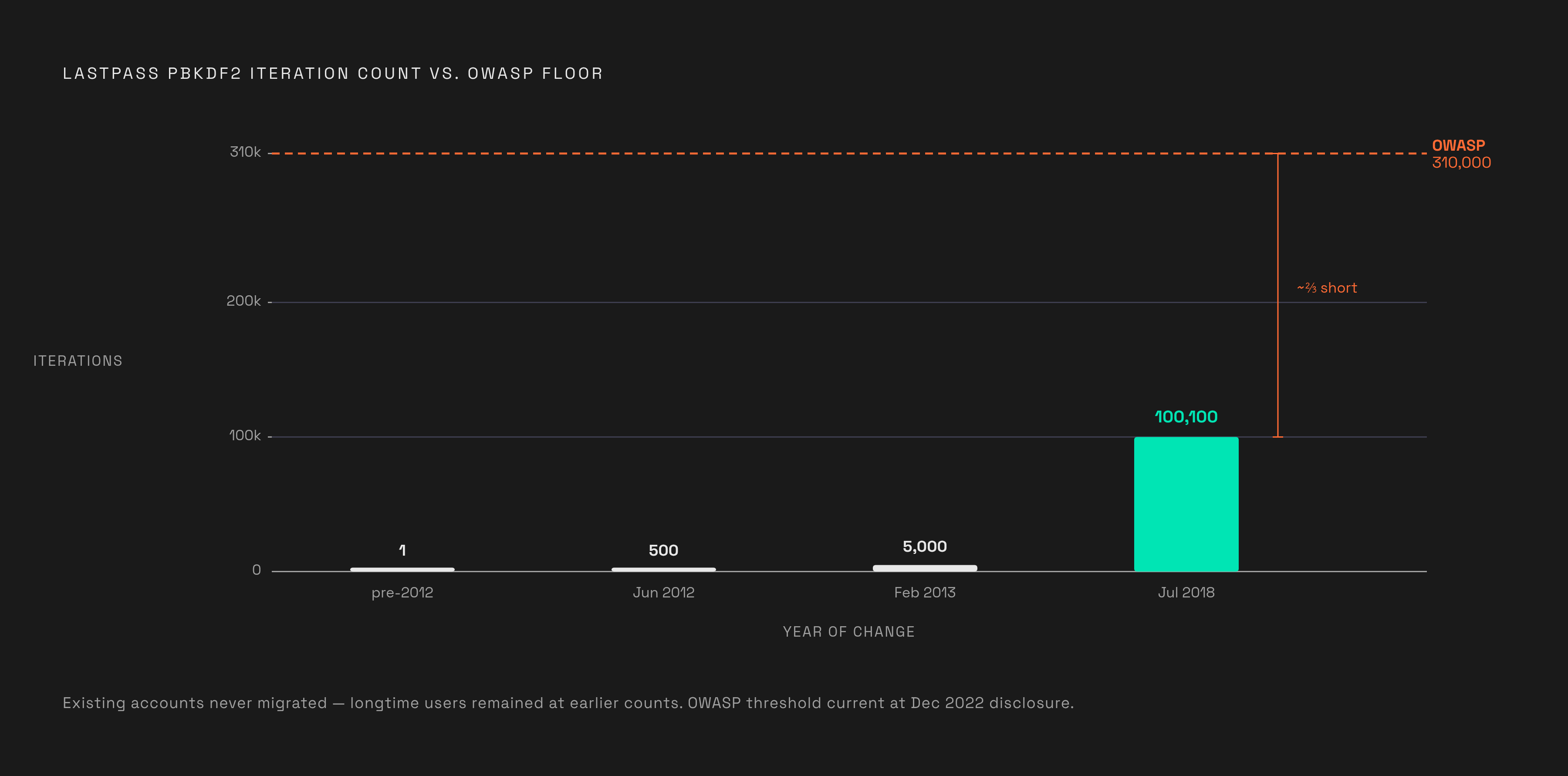
The AES-256 algorithm held structurally. What determined whether protection held in practice was the key derivation parameters, and for many accounts those parameters were weak enough to make offline cracking economically viable. LastPass used PBKDF2 to derive the encryption key from the user's master password. The number of iterations determines how computationally expensive it is to test each password guess. LastPass's default iteration count rose over time, from 1 to 500 in June 2012, to 5,000 in February 2013, to 100,100 in July 2018. But the company never successfully migrated existing accounts onto higher iteration counts, so longtime users remained on older, weaker settings.
PBKDF2 has a structural disadvantage compared with modern alternatives such as Argon2: it runs efficiently on GPUs and specialized hardware, exactly the equipment an attacker holding an offline copy of the vault database would use. In its December 2022 disclosure, LastPass described its 100,100-iteration figure as "stronger than typical," at the same moment security researchers were characterizing that count as far below the contemporaneous OWASP guidance, which recommended 310,000 iterations. The stolen backup is frozen at the parameters it had at the time of exfiltration.
The downstream consequences: cryptocurrency thefts continuing years after the 2022 exfiltration
Because the attacker holds vault backups offline, the 2022 exfiltration created an exposure window that remained open years afterward. The evidence suggests exactly that happened. Researchers Bax and Monahan found that none of the six-figure cyberheist victims showed signs of the attacks typically preceding high-dollar crypto theft, such as compromised email or SIM swapping. But all had stored cryptocurrency seed phrases in the Secure Notes section of their LastPass accounts prior to the 2022 breach. A subsequent wave of drained wallets was detected as recently as September 2025, with additional funds traced through Wasabi Wallet between late 2024 and early 2025.
The attribution question remains unresolved in a specific way. LastPass has maintained it has not been made aware by its law enforcement partners of any conclusive evidence connecting the cryptocurrency thefts to the LastPass breach. That position sits in tension with the federal seizure complaint's language. The tension itself is informative: it reflects the difference between what an encrypted vault theft implies probabilistically and what a legal proceeding requires evidentially.
Where exactly in the chain each failure point could have broken the sequence
The exfiltration chain had at least five distinct failure points where a different organizational or technical decision would have stopped or severely limited the attacker's progress. Each maps to a control category that was either absent or misconfigured. First, personal device security. A more-than-two-year-old unpatched vulnerability on an employee's personal home computer was the proximate entry point for Stage Two. Mandatory patching policies and restrictions on running third-party software on machines holding corporate access credentials would have removed this vector. Second, separation of personal and business vaults. The engineer's personal and corporate vaults shared a single master password, so compromising one compromised both. Organizational policy requiring distinct, isolated credentials for personal and business use would have contained the blast radius. Third, access concentration. Only four engineers held the decryption keys to the entire production cloud environment, and the attacker's documented targeting behavior shows they knew this and deliberately chose the path of least resistance. Distributing key custodianship or requiring multi-party authorization for key use would have raised the cost of this stage.
Fourth, post-authentication behavioral monitoring. The attacker operated with valid credentials for nearly three months before GuardDuty alerted, after data was already exfiltrated. Runtime monitoring of what authenticated sessions actually do, not just whether they authenticated legitimately, would have flagged the reconnaissance and enumeration activity earlier. Fifth, key derivation parameters. Accounts protected by historically low PBKDF2 iteration counts were never migrated to stronger settings, making offline cracking economically viable for those vaults. Proactive forced migration of existing accounts to current parameters would have narrowed the cracking-viable population.
Regulatory accountability and what the ICO's finding established beyond the fine itself
The failure-point analysis is not retrospective criticism. It has been formalized in regulatory findings. The UK Information Commissioner's Office concluded that strong encryption, while necessary, does not satisfy security governance obligations where broader organizational controls, particularly around personal device use and account separation, are deficient. The ICO issued a penalty of £1,228,283 to LastPass UK Ltd on November 20, 2025, finding that LastPass's failure to implement appropriate technical and organizational security measures allowed a threat actor to exfiltrate personal data relating to approximately 1.6 million UK-based customers.
The regulatory reasoning matters more than the amount. The ICO independently arrived at the same failure-point analysis the chain anatomy produces, anchoring it in legal obligation rather than hindsight critique. The breach also resulted in a class action settlement, with LastPass settling in 2025 for $24.45 million covering losses by customers whose vaults had been accessed.
What the 2026 Klue incident shows about whether the underlying pattern has been resolved
The 2022 breach was followed by substantial post-breach remediation investment. A June 2026 supply chain breach shows that the structural vulnerability remained. On June 23, 2026, LastPass disclosed a breach involving Klue, a market intelligence platform used by LastPass's go-to-market teams. Attackers compromised Klue via a dormant legacy credential, harvested OAuth tokens Klue held on behalf of its customers, and used those tokens to access LastPass's Salesforce environment and exfiltrate CRM data. The 2026 incident did not involve vault data, and the scope should not be inflated. Third-party access monitoring is an unsolved industry problem, not a correctable one-time failure.
The single-secret model and what it implies for any system where one credential controls a large data estate
The LastPass breach illustrates a structural property of single-secret access models. When one credential controls access to a large, sensitive data estate, whether a password vault, a cloud environment, or an agent's inherited permissions, the entire protection model is as strong as the weakest link in that credential's custody chain. LastPass's zero-knowledge architecture correctly placed the encryption burden on the master password. That design decision also made the master password the single point of catastrophic failure, and its custody extended all the way to a personal home computer running unpatched third-party software.
The parallel for enterprise AI agents follows naturally. The fix the breach anatomy points toward is not abandoning password managers or reducing agent capabilities. It is adding the monitoring and enforcement layer that treats post-authentication behavior as the real security perimeter: detecting anomalous enumeration and exfiltration activity against a baseline, not just verifying that the session began legitimately. Real-time behavioral monitoring of authenticated sessions was the control category absent at the decisive stage of the LastPass chain. It remains the gap that purely identity-based governance cannot close.


