Audit Log Design Patterns That Would Have Detected Historical Breaches Earlier
Specific audit log designs could have caught SolarWinds, Marriott, and Equifax years earlier.

Summary
Specific audit log designs could have caught SolarWinds, Marriott, and Equifax years earlier.
The tools to catch every breach in this article already existed at the time each one happened. SolarWinds sat undetected for over a year. Marriott carried an intruder inside the Starwood network for four years, from 2014 until the breach was finally shut down in 2018, two years after the 2016 acquisition. Equifax took weeks to notice. T-Mobile's API abuse ran for over a month. None of these gaps came from attackers outsmarting intrusion detection. They came from log architectures that never captured the signal in the first place, so there was nothing for any analyst, however sharp, to find.
The lower bound on how bad this gets is a children's health plan provider, unnamed and predating 2020, where a vendor failed to patch known software vulnerabilities for seven straight years and never built an audit log capable of catching what was happening. Seven years is an absence of the concept of detection.
The financial case for closing that gap is direct. IBM's 2025 Cost of a Data Breach report found that breaches contained within a shorter lifecycle correlate with materially lower cost. Detection speed is a line item, not just a security posture. Reverse-engineering what each of these five breach architectures failed to log, and failed to flag, turns out to be a far more useful exercise than another round of "log more." The specific record that should have existed, and didn't, tells you what to build instead.
The structural blind spots built into standard logging
Logging gaps are not laziness. Logging standards made these trade-offs on purpose, so the same gaps appear at companies that have nothing else in common. OWASP's A09 category, Security Logging and Monitoring Failures, names the pattern with blunt precision: auditable events that never get logged, logs that never get centralized, alerts that exist but never get actioned, and sensitive data that leaks into or out of log files that were never built to hold it.
A 2025 academic study, "Beyond Collection: Measuring the Detection Efficacy of Modern Security Logging Standards," put a number on one piece of that trade-off. Because POST body data is routinely excluded from logging standards for privacy reasons, 27 of 32 POST-only web vulnerabilities in the study produced no detectable signal anywhere in standard log fields.
Event volume is a genuine constraint: a busy Kubernetes cluster can throw off millions of events a day on its own, and logging all of it indiscriminately buys you alert fatigue and a storage bill, not security. The field hasn't resolved the tension between privacy and cost on one side and detection completeness on the other, and it probably won't anytime soon. The right frame is intentional pattern design rather than sheer volume: which specific events, structured which way, centralized where, alerting on what threshold. OWASP's Top 10 doesn't have another category this focused on shrinking dwell time rather than stopping the initial break-in, and that's a tell. Detection design is its own discipline, separate from prevention, and it has its own rules. The five breaches below are where those rules get tested against reality.
SolarWinds: build-pipeline and DNS log gaps
SolarWinds went undetected for over a year because the attack lived almost entirely on two surfaces that most organizations never bothered to log: the build pipeline and DNS traffic.
Changes to build infrastructure and code-signing pipelines were not treated as auditable security events, and that's still true at most companies, because CI/CD systems get managed by engineering teams as engineering tools, not watched as security surfaces with their own audit trail. A log entry marking who modified the build process, when, and what changed would have been the first tripwire, and it didn't exist to trip.
The second gap sat in DNS. SUNBURST used DNS requests to a command-and-control domain, avsvmcloud.com, built to resemble legitimate Orion traffic closely enough to pass casual review. But the domain itself was strange, and any DNS pattern analysis running against audit logs had the raw material to flag it as anomalous. No such analysis was running. Layered on top of that, the attackers moved laterally using legitimate stolen credentials. Ingress and egress traffic analysis was the second control that could have caught them and didn't exist either.
The fix implied by this gap extends the audit trail's scope to named categories: operating system events, application logs, database transactions, API calls, network flows, identity provider logs, infrastructure-as-code changes, service-to-service calls, and deployment pipeline events. Provenance graph logging models causal chains: who spawned what process, what file it touched, what network connection followed from that. Applied to SolarWinds, a provenance graph would have rendered SUNBURST's credential pivoting as a visibly anomalous chain of cause and effect. Research presented at the IEEE Symposium on Security and Privacy in 2024, including R-CAID, FLASH, and Kairos, has pushed this approach forward, with R-CAID in particular building root cause analysis directly into provenance-based intrusion detection so that an attack can be reconstructed after the fact from audit records alone.
Marriott/Starwood: cross-entity log strategy at acquisition
Marriott didn't fail to watch a known environment closely enough for four years. There was no log strategy for the Starwood network at all, because nobody had established one when the acquisition closed.
The intruders were inside Starwood's systems from 2014, two full years before Marriott's acquisition completed in September 2016, and they stayed in until 2018. No cross-entity audit log strategy was set up at the point of acquisition. Nobody baselined what normal traffic on the inherited network looked like, and no lateral movement alerting was calibrated to the newly combined environment. The breach wasn't hiding from a system built to catch it. It was running inside a network nobody had yet agreed to watch.
The design pattern that follows is specific: the first security action on inheriting any network, whether through acquisition or any other integration, should be a full behavioral baseline of existing traffic, followed by anomaly alerts tuned to deviations from that baseline. Lateral movement across an inherited network should be treated as unknown-origin by default until that baseline exists, not after. The same structural problem occurs in AI agent governance: when an agent inherits human-scale access and operates at machine speed across systems built for a different kind of actor, the old access model doesn't automatically stretch to cover it, and a fresh baseline has to be designed on purpose.
Equifax: traffic inspection gaps and log integrity
Equifax's 76-day dwell time wasn't the product of a clever attacker. A single misconfigured device, running an expired digital certificate, quietly disabled traffic inspection, and nothing in the logging architecture treated that silence as an alarm.
The expired certificate removed Equifax's primary detection surface. Around that single point of failure sat a broader structural problem: operational and security responsibilities were split between two separate executives, with the security chief reporting up through the legal function rather than alongside IT operations, and periodic audits of Equifax's data security practices had already rated the company near zero before the breach. Nobody monitored the health of the monitoring system itself. When inspection went dark, the absence of log data should have been the loudest signal of the entire incident, and instead it registered as nothing.
The pattern that follows is to treat log pipeline health as its own monitored system: silence in a stream that should be active is an alert condition, not a neutral state. A second, related pattern belongs here too: tamper-evident log integrity. A 2025 paper from ACM CCS, "Rethinking Tamper-Evident Logging," proposes a co-designed auditing system using message authentication codes to detect when logs have been altered after the fact. Applied to Equifax or to Marriott, that kind of control would have exposed any attempt to erase tracks after the intrusion. An immutable audit trail needs both tamper resistance and a way to verify it, not just a timestamp. Locked retention on cloud audit logs is a solid baseline, but verifying that a log is complete and unmodified is a separate job that locked retention alone doesn't do. Recent incidents confirm the pipeline itself can simply fail: in November 2024, Cloudflare lost about 55% of the logs it normally sends customers for roughly 3.5 hours, after a configuration bug cascaded into a buffering system overload. Microsoft has had comparable logging outages. Neither was a breach. Both are proof that the pipe carrying the evidence can break on its own, with no attacker involved.
Target: vendor-access log scope and rate alerting
Target's breach was detectable at the moment the stolen credentials were first used, but only if vendor access was logged at all and watched for behavior that didn't match the vendor's normal pattern. Neither condition held.
Malware, reportedly the Citadel Trojan, a credential-stealing tool, got onto a vendor's systems and captured login credentials for Target's Ariba billing platform. From there, the attackers pivoted into point-of-sale production data and walked out with tens of millions of customer records. Simply logging failed login attempts would have helped catch this in time. That log either didn't exist or wasn't watched, and the gap let the intruders walk straight through.
The specific absence was a vendor-access audit log with rate-anomaly alerting built in: access from a third-party credential into systems outside that vendor's normal scope, at odd hours or unusual volume, never triggered anything because nothing was built to notice. The fix is to log vendor and third-party access as its own category, with a behavioral baseline set per vendor identity, not lumped in with general user traffic. Three dimensions should drive alerts on their own: which systems a vendor credential touches, what times it's active, and how much volume it moves. Having the log but skipping the rate-anomaly alert on top of it is nearly as useless as never logging the access. The log tells you what happened only after you've already lost the thing you were trying to protect.
T-Mobile API breach: API traffic pattern logging
T-Mobile's API breach ran for over a month because nobody was analyzing API traffic for behavior, only for whether a request was technically valid. High volume from a single source, hitting at abnormal times, never counted as alertable on its own.
API access logs existed. What was missing was analysis across three behavioral dimensions that separate abuse from ordinary heavy use: request frequency tied to a specific identity, concentration of traffic from a narrow set of source addresses, and a distribution of access times that doesn't look like a human being on a normal schedule. The design pattern that follows is concrete: every API audit log entry should capture the requesting identity, the source IP, the endpoint accessed, the response size, and the timestamp, and alerting needs to run against rate anomalies per identity, not just per endpoint. An endpoint can look fine under load even when one identity is hammering it.
Kubernetes environments offer a working model of what that looks like as an actual query rather than a policy statement: flagging anonymous or unauthenticated requests that nonetheless succeed, or pod exec sessions launched from outside CI pipelines or designated break-glass accounts. Each is a specific field-level filter that turns a hunch about bad behavior into something a log can answer. The scale of the exposure keeps growing too: a substantial share of 2025 breaches involved data spread across multiple cloud environments, and those multi-cloud breaches ran materially more expensive on average than incidents confined to on-premises systems.
Four log design patterns that address the gaps across all five cases
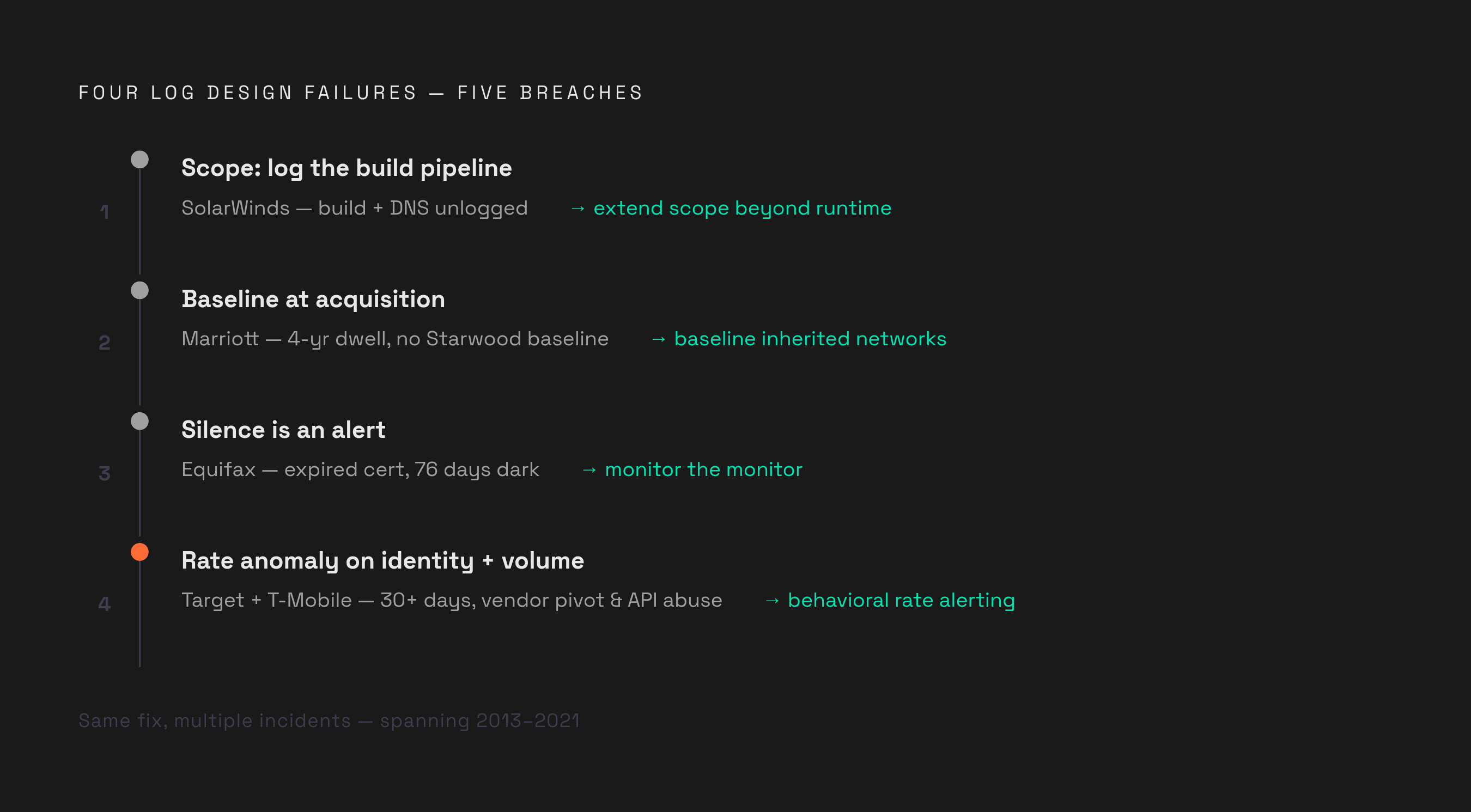
Five breaches, five sectors, nearly a decade of spread between the earliest and most recent, and they collapse into four recurring log design failures, each with a fix that would have shortened the window the attacker got to work in undisturbed.
Scope extension beyond runtime systems is the first. SolarWinds showed that you need to log build pipelines, code-signing infrastructure, and DNS traffic as security events in their own right, and you can't leave them to whichever engineering team happens to own the tooling.
Baselining at organizational boundaries is the second. Marriott showed that an inherited network, whether from an acquisition or any other integration, needs a behavioral baseline and lateral-movement alerting built fresh and calibrated to the new combined environment.
Monitoring the monitor, paired with tamper evidence, is the third. Equifax showed that silence in a log stream that should be active is itself an alert condition, and the ACM CCS tamper-evident logging work shows a concrete way to detect when an attacker has gone back to erase the trail.
Behavioral rate-anomaly alerting on identity, scope, and volume is the fourth, and it runs through both Target and T-Mobile. A vendor credential reaching outside its normal systems, or an API identity spiking in frequency or clustering from one source at odd hours, is a pattern a log can be built to catch, provided someone decided in advance that catching it mattered.
None of these four patterns demand logging everything. Each demands logging the right thing, structured so an anomaly actually looks like one instead of disappearing into the volume problem that makes "log everything" useless in practice. An audit trail that exists on paper would not have ended any of these five breaches months, or years, sooner, but one built on these patterns would have.


