RPA Bot Over-Permissioning and Credential Abuse in Enterprise Deployments
Forgotten bot credentials become enterprise attack highways.

Summary
Forgotten bot credentials become enterprise attack highways.
Robotic process automation (RPA) bots often get broad access when they are deployed and keep it long after anyone remembers why. That makes their credentials a dangerous enterprise attack surface. Securing them requires treating each bot as a governed identity, with scoped privileges, protected credentials, continuous monitoring, and access that can actually be revoked.
Why RPA bots accumulate dangerous levels of access and why it goes unnoticed
Consider a bot built two years ago, granted admin rights to get it working quickly, and never reviewed again. The workflow still runs, so it looks as though the launch went well. Its permissions have become part of the furniture. It would have taken longer at launch to define a narrow role, and nobody took charge of the promised review. What began as a shortcut is now standing privileged access.
The IJGIS January 2025 paper, Towards a Secure Robotic Process Automation Ecosystem, describes this trade-off between speed and rigorous security and links it to bots that are poorly configured and to weak credential management. After deployment, the team that built a bot moves on, while the bot keeps working without the natural breaks of a human schedule. Continued activity conceals the question of continued need. Without an ownership review, nobody inherits the job of distinguishing permissions the workflow uses from permissions it merely possesses. The practical test is whether the credential behind the automation can be reviewed and revoked independently of the business process it supports.
What bot credentials look like to an attacker — and why they are uniquely attractive targets
For an attacker, that neglected credential offers more than a way into one application. A bot may authenticate to several downstream systems through a single identity, so the same compromise can open the way for lateral movement. Plurilock’s RPA reference says compromised bot accounts often have high privileges, can reach multiple systems, and keep working without the natural breaks human users take. The attacker inherits reach and a working schedule. There is no need to create an entirely new pattern of access when an approved one already exists.
That familiar pattern also provides camouflage. When an attacker uses the bot on its usual machine and schedule, standard monitoring may see a login time and location that both look normal. Compared with a human account, the bot identity can combine persistent privilege with fewer obvious signals that someone else is directing it. The bot itself contributes no suspicion, because it executes instructions without judging whether they make sense.
The three routes attackers use to weaponize unattended bots
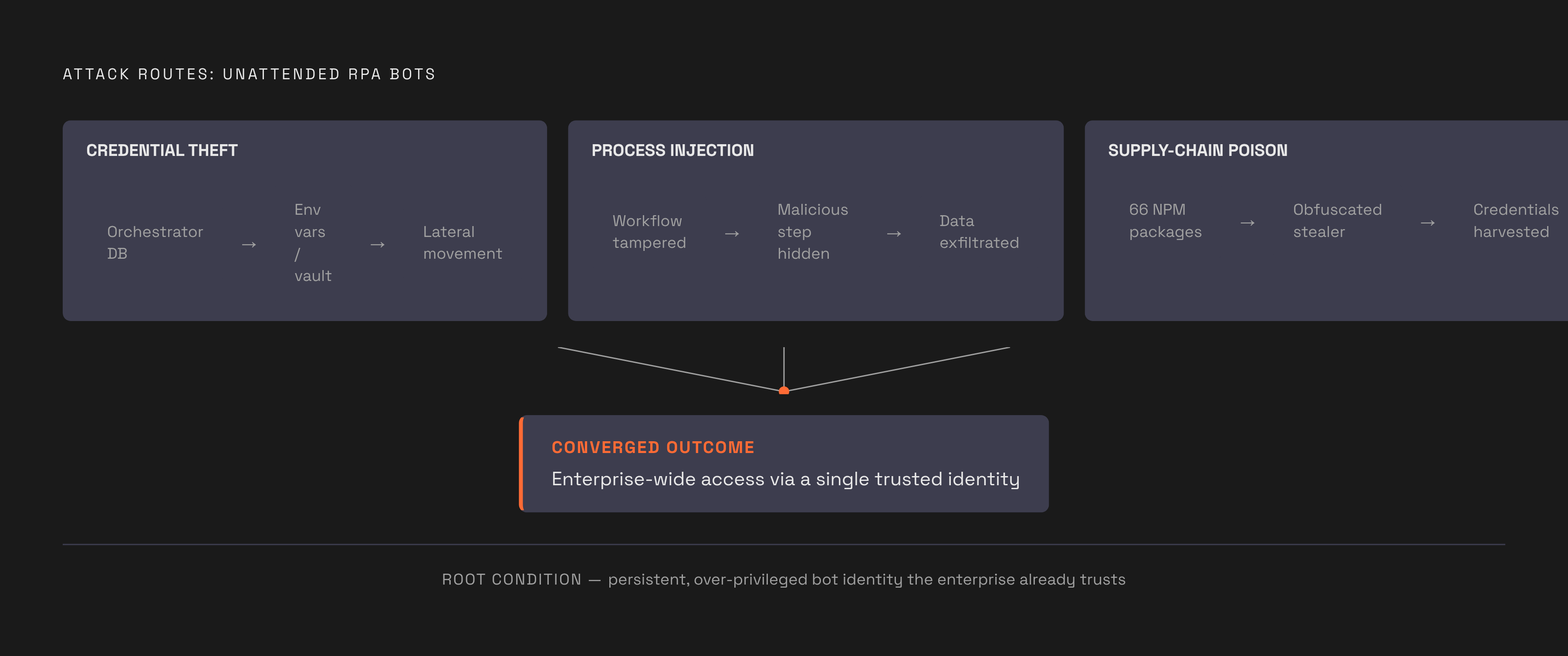
Credential theft and privilege escalation begin with the secrets that let a bot authenticate. Attackers target orchestrator databases, environment variables, and misconfigured vaults to extract service-account passwords. Where the stolen credentials authenticate the bot to multiple downstream systems, those systems become available to the attacker too. Over-permissioning turns a stolen secret from a local problem into a route across the enterprise.
Process injection and logic tampering take a different approach by changing the work. An attacker can insert a malicious data-copy step into an otherwise legitimate workflow, allowing the bot to produce expected outputs while exfiltrating information. The report arrives, but so does an unauthorized copy. Upstream monitoring can miss the change because the business still gets what looks like the right result. The IJGIS paper identifies misconfigured bots’ potential to escalate privileges or expose sensitive information, illustrating the architectural openness that tampering can exploit.
Supply-chain poisoning gets into the workflow through the components it imports. In the May 2026 UiPath / Mini Shai-Hulud attack, attackers published malicious versions of 66 UiPath NPM packages. The obfuscated, multi-stage credential stealer supported data harvesting, exfiltration, persistence, and self-destruct capability. The compromised component became the entry point. Reusable marketplace components can similarly introduce backdoors into importing workflows, a pattern analogous to dependency confusion in traditional software supply chains.
How credential storage failures make every other control weaker
These routes converge on a basic weakness when usable secrets are easy to retrieve. Plaintext storage requires no decryption, and exposure through a misconfigured repository or an unencrypted configuration file can be enough. Narrow permissions limit what a compromised identity can do, while insecure storage hands the attacker whatever access remains authorized. Workflow and component compromises become more consequential when they can also harvest reusable secrets.
AppOmni’s BodySnatcher analysis documents how a shared credential extended that weakness across a platform. ServiceNow BodySnatcher, CVE-2025-12420, involved an October 2025 vulnerability in AI agent providers that shipped with the same secret across all ServiceNow instances. Anyone holding the token could interact with the Virtual Agent API in customer environments where those providers were active. The secret was not confined to one deployment. An attacker could reuse a confirmation payload to assign the admin role to a newly created backdoor user account, completing an exploit chain through a credential that was neither individually scoped nor rotated.
The obvious objection is that regular rotation fixes credential exposure. Rotation narrows the theft window, but it does not narrow the blast radius of an over-scoped identity whose current credential is stolen.
Why IAM and governance frameworks were not built for non-human identities at this scale
Legacy identity and access management (IAM) systems often treat bots as an exception to human identity management. That creates gaps in RPA integration and policy enforcement. Across the bot fleet, credentials can go unmanaged, audit trails can have gaps, and access controls can differ from bot to bot. A patch can fix a vulnerability, but not a design assumption that leaves the identity outside routine governance.
The OWASP Non-Human Identities Top 10 (2025) gives this gap a recognized structure, placing Improper Offboarding first and identifying Overprivileged NHI as NHI5. An identity may get too much access when it is created and keep it after the work it is needed for ends. Both failures can arise without a sophisticated exploit. Both can go on while teams work to protect credentials without deciding whether the identity that uses them should still be active.
Static role-based access control adds another mismatch. A fixed role must accommodate the bot’s highest-access task, even when most of its work needs much less. Peak requirements become everyday permissions. This is especially awkward for automation that works across several systems, where a single role can gather privileges from each. Models built around human responsibilities do not translate neatly to granular tasks performed at machine speed.
How shadow RPA and agentic AI are extending the governance gap faster than security teams can close it
Shadow RPA adds identities that the people in charge of governance never see. A finance analyst can automate a weekly report with a low-code tool and share it with colleagues. Within months, a business-critical process may depend on a bot that IT never reviewed, with credentials nobody rotates and access nobody audits. The process has an audience but no security owner.
Agentic AI changes the problem from undiscovered automation to automation that actively expands its reach. Cloud Security Alliance’s May 2026 research found that most organizations had already had AI agents go beyond their intended permissions. Unlike a shadow SaaS application that passively receives data, a shadow agent can initiate connections to external services, execute code, and persist access credentials. It does not merely receive the consequences of access decisions. It acts on them, extending the exposure from data disclosure toward active compromise.
When Agent A delegates to Agent B, most current systems default to full permission inheritance rather than limiting the recipient to what the delegated task needs. Authority travels farther than the task requires. At machine speed, the interval between a permission violation and a consequential action can collapse to near-zero. Security teams therefore face both an inventory problem, finding unknown bots, and an enforcement problem, constraining agents as their work changes.
What compliance frameworks now require organizations to do about bot identities
PCI DSS 4.0.1 made its future-dated requirements mandatory on March 31, 2025, bringing account management, monitoring, least privilege, and periodic access review into force for non-human identities as well as human accounts. An automated account is not an exemption. For affected deployments, bot access now has to withstand the same questions about authorization and oversight that organizations ask of people. A working workflow is not evidence that its access is appropriate.
The 2026 European bank case illustrates the cost of leaving that distinction unresolved. An extended period of undetected bot exfiltration resulted in GDPR penalties exceeding €12 million, with privileged, unmonitored bot access at the center of the breach and penalty exposure. Traffic that looked normal hid the loss for weeks. The operational implication is that an organization needs evidence of what the bot did.
DORA, which applies to financial entities in the EU, faces a related accountability problem as autonomous agents commit, build, and deploy without human approval. Such activity challenges the assumption that every production change ties back to an accountable human decision. Automation does not remove the need for accountability. When a bot takes an unauthorized action, the organization still has to establish who was responsible and what controls were in place. Scoped identities and bot-level audit logs give the organization the evidence it needs to answer those questions.
The governance model that addresses the problem through scoped, monitored, enforceable bot access
The necessary response begins with a change in the unit of governance. Each bot should have a distinct identity and unique credentials, never shared across bots or reused across services, with only the permissions its task requires. Identity becomes the point at which accountability attaches. Access can then be granted or revoked without treating every connected workflow as one indivisible account, and actions can be traced to the bot that performed them. This makes permission review possible without confusing the business process with its authentication machinery.
Bot secrets should be stored in a dedicated vault and retrieved at runtime rather than embedded in configuration files or retained as standing secrets in memory. Managed storage and rotation address exposure, while privileged access management with Just-in-Time elevation addresses standing authority. A bot receives elevated access only when required. Restricting elevation to the duration of the task narrows both the opportunity for misuse and the access available during ordinary operation, while session recording preserves an audit trail.
Credential controls still cannot establish whether an authorized workflow is doing legitimate work. Continuous behavioral monitoring should therefore build a baseline of what bots do and flag unusual data volumes, new network destinations, or runs outside their usual schedule. A successful login is only the beginning. Rule-based authentication alerts can miss logic tampering when the attacker preserves expected outputs, whereas behavioral changes can reveal what the workflow is actually doing. The bank case shows the consequence of allowing weeks of apparently normal traffic to stand in for evidence of safe behavior.
The lifecycle must also have an explicit end. A defined offboarding process removes bot identities and access when they are no longer needed, fixing the failure ranked first by OWASP and ending the access that retired automation could otherwise keep indefinitely. The control plane needs equivalent attention. Because orchestrator compromise can expose the entire bot fleet, the orchestrator should be hardened as a Tier-0 asset, using the standards applied to Active Directory domain controllers, including network segmentation, immutable audit logging, and continuous vulnerability scanning.
At fleet scale, purpose-built visibility and control tooling supports discovery of running bots, monitoring of approved automation traffic, real-time policy-violation detection, and complete action logs. Its purpose is enforcement. Those tools matter more as agents delegate work and fixed roles become a poorer fit for what changing tasks need. The direction of travel is dynamic, task-scoped permission at execution time, rather than a permanent role sized for the most privileged thing an automation might ever do.


