Implicit Trust Between Internal Services and Its Breach Consequences
One compromised service becomes a beachhead for attackers to reach others without additional checks.

Summary
One compromised service becomes a beachhead for attackers to reach others without additional checks.
Implicit trust between internal services turns a single compromise into a path through an organization. One service can fail, and downstream services accept its calls without asking whether they should. Stopping that cascade takes explicit checks at each service boundary and runtime controls that can both record unauthorized actions and stop them.
Why internal services trust each other by default — and what that assumption actually means
Internal services communicate through APIs, but an API call does not necessarily bring an authorization check with it. Without explicit policy, the receiving service may treat an internal request as pre-authorized because it came from inside the network perimeter. That convention can remain invisible until someone questions it or exploits it. When a senior developer leaves, the reasoning behind the convention may leave too, while the services continue honoring it.
Consider Service A, which validates user tokens before calling Service B under its own service identity. If Service B trusts internal traffic without re-verification, an attacker who compromises Service A gains unrestricted access to Service B’s data. A similar handoff occurs when an API assumes its upstream caller already sanitized input. If that assumption is wrong, the unchecked handoff becomes an injection surface.
These arrangements depend on a boundary that cloud-native deployment, container orchestration, and multi-cloud workloads have made less distinct. Supply-chain compromises, container escapes, and direct service access can let an attacker into the zone thought to be safe without going through its expected entrance. This leaves services at risk even before anyone steals a credential. Implicit trust is so pervasive because it is often a design default.
How microservices architecture multiplies the number of implicit trust relationships at scale
Decomposing an application creates more places where one service must decide whether to accept another’s request. Every new service adds relationships through its APIs, data flows, and dependencies, and those relationships are rarely all defined as explicit security policy. Enterprise service graphs contain hundreds of interconnected components, changing as services are deployed, integrated, or retired.
Alboqmi and Gamble’s 2025 research at the University of Tulsa finds that microservices architecture applications carry substantially more vulnerabilities per application than monolithic architectures. Decomposition enlarges the attack surface, while the changing service graph makes that surface harder to review. Traditional threat modeling assumes that a system has clear boundaries and stays much the same, but a workshop can take weeks while the architecture keeps changing. Static documentation describes a version of the system that attackers are under no obligation to use.
As this complexity grows, teams can respond by concentrating security effort at the edge. Internal services then receive minimal controls because the perimeter is expected to hold. That creates an inverse relationship between the complexity of the interior and the scrutiny applied to its calls.
What attackers actually do once they are inside an implicitly trusted network
An attacker’s first task after gaining access is often to discover what that access can reach. Reconnaissance can include mapping Active Directory, scanning ports, and enumerating services with native administrative tools including net view, nltest, and PowerShell. The attacker then gains credential access and moves to more hosts through legitimate management protocols. Without behavioral baselining, these steps can raise few alerts because administrators use the same tools.
Movement and privilege escalation reinforce each other. An attacker reaches a service or identity that offers greater privileges, then uses those privileges to reach more systems. Standing privilege gives identities more access than they need, while flat internal connectivity gives them routes to other systems. When destination services accept credentials and internal origin without more checks, what an attacker does can look like ordinary traffic. The architecture has already opened the doors.
Ransomware operators exploit this freedom before deploying encryption. They move laterally to map the environment, disable backups, escalate privileges, and position payloads across systems before triggering them simultaneously. Implicit trust makes that preparation fast and quiet. AI agents add another surface because they discover tools, chain calls, and act autonomously under service-level access. A manipulated agent can follow the same trusted paths at machine speed, without the behavioral signals associated with human-speed movement.
How breach consequences compound at each hop — the cascade in practice
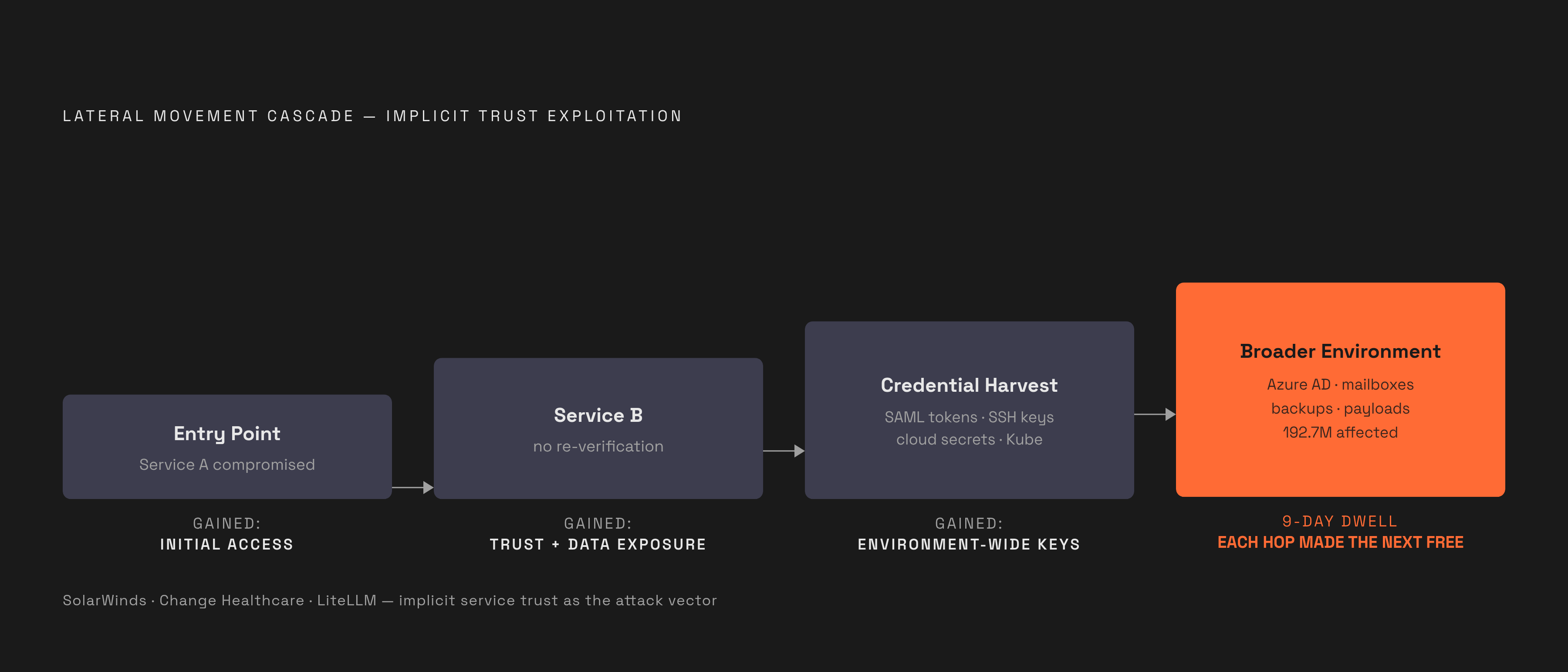
Each successful hop changes what the attacker can do next. A newly reached service may expose data, credentials, or privileges that were unavailable at the entry point. Those credentials let the attacker reach more of the surface, where there are more chances to gain access. Each compromise can become leverage for the next.
SolarWinds in 2020 illustrates how this leverage crosses different kinds of trust. Attackers compromised a trusted software vendor and used its pre-authorized update channels to get into organizations that included federal agencies and major corporations. Inside networks, the SUNBURST intrusion used forged SAML tokens obtained through the Golden SAML attack on the ADFS signing certificate. Those tokens enabled access to cloud mailboxes and Azure AD environments without triggering standard MFA checks because they appeared valid from the identity provider’s perspective. Trust in software delivery opened the route inward, and trust in identity assertions extended it.
Change Healthcare in 2024 shows the operational consequences of leaving that route open. Attackers gained remote access to a server lacking multifactor authentication, then moved laterally for nine days. The resulting disruption to payments and patient care lasted months, with at least 192.7 million individuals affected. That time inside let attackers reach far beyond the first server. The consequences spread into a connected healthcare ecosystem rather than remaining a problem for the breached organization alone.
The LiteLLM cascade in March 2026 shows the same pattern through a software dependency. TeamPCP used a compromised Trivy security-scanner GitHub Action in LiteLLM’s CI/CD pipeline to push malicious versions to PyPI. The payload harvested AWS, GCP, and Azure credentials, along with SSH keys and Kubernetes secrets, upon Python startup in v1.82.8 or the first import of the proxy module in v1.82.7. Here, legitimate delivery channels brought the payload to credentials that could support further access.
Where implicit trust silently accumulates in modern architectures — the structural blind spots
The first place to locate implicit trust is the receiving end of a service-to-service call. A service may accept any caller from its network segment, treating reachability as evidence of permission. A service mesh can preserve the same assumption if it provides secure communication without per-request authorization. Input validation is another blind spot when each service expects the one before it to have done the work.
Build pipelines, package registries, and dependency updates form another concentration point because they deliver through channels already authorized by the organization. The LiteLLM case demonstrates how trust in delivery can stand in for judgment about the delivered payload. Shared identity infrastructure concentrates trust differently. When many services accept the same identity provider, compromise of its certificates or tokens can spread access across those services. SolarWinds’ forged tokens exposed the consequence of treating one trust root as sufficient proof everywhere.
When containers disappear within seconds, it can be hard to keep persistent audit trails, so movement through ephemeral workloads may leave no record that can be recovered. Management systems can also hold information that helps attackers get into other systems. Marquis’s lawsuit against SonicWall alleged that a flaw in SonicWall’s cloud backup service exposed firewall configuration files containing credentials, MFA bypass codes, and VPN configurations used to enter Marquis’s network. The allegation illustrates how a management repository can become a reconnaissance asset.
Why standard defenses fail to detect or stop lateral movement through trusted channels
Perimeter controls remain useful, but their position limits what they can do about interior trust. API gateways, WAFs, and network firewalls deployed at the edge evaluate traffic crossing that edge. From that position, they cannot inspect every service-to-service call that follows. Once the attacker is inside, a legitimate credential and a familiar protocol can make malicious movement look routine.
Detection based on known-bad signatures also struggles when the attack medium is normal administration. PowerShell or a remote management protocol is not, by itself, evidence of misuse. Behavioral baselining instead asks whether an identity or host is acting as it normally does. That helps distinguish suspicious use from ordinary work, but detection alone does not revoke access. An alert still leaves a gap between recognizing a problem and stopping its spread.
Partial zero-trust deployments can leave the same interior paths unaddressed. Alboqmi and Gamble’s 2025 research finds that existing service mesh solutions lack runtime trust evaluation, securing transport without continuously assessing the microservice behind it. A mesh control plane that is misconfigured or compromised can itself grant too much trust. Logs remain valuable evidence, but a cascade may outrun the analyst reviewing them.
The architectural response: making internal trust explicit and enforceable at every service boundary
The corrective principle is to require proof of identity, scope, and authorization at the moment of an internal call. Mutual TLS sets the transport-layer baseline by making both services show cryptographic proof of who they are. That replaces presumed safety based on internal origin with a verifiable claim. However, proving which service is calling does not establish that every request it makes is allowed. Per-request authorization must supply that distinction.
Least-privilege service identities then limit how far a compromised caller can reach. Each identity should have access only to the downstream services it legitimately needs. If Service A is authorized to call Services B and C, that identity should not directly open Services D through Z. The same limits must apply at subsequent boundaries to contain further propagation. Each receiving service must also validate and sanitize its own inputs, even when an upstream service promises to have done so.
Runtime trust evaluation addresses the separate question of whether an authenticated workload remains trustworthy. Alboqmi and Gamble’s 2025 research proposes and tests continuous evaluation within a service mesh, assigning trust scores based on current vulnerability posture, including timely patching of third-party libraries. Their evaluation uses the Train Ticket MSA benchmark on Kubernetes with Istio. The approach allows deteriorating vulnerability posture to reduce a service’s trust score and restrict its access in real time.
Microsegmentation complements these checks by limiting the paths available for movement. Main Line Health deployed identity-based microsegmentation across a large health system, automatically cataloguing over 100,000 devices and activating blocking rules on day two. The deployment demonstrates that containment controls can operate at substantial scale in a regulated environment.
Runtime visibility and policy enforcement as the operational requirement — not just logging
An explicit-trust design still needs operational control because the running environment does not stand still. Services change, and teams may deploy agents without a central view of what those agents can access. Organizations need to discover every agent, understand its permissions, and detect behavior outside its role. Every approved AI traffic flow, including agent-to-agent and agent-to-service calls, must be observable in real time. A diagram cannot govern a tool call it does not know exists.
That visibility must connect to rules that can stop unauthorized behavior. A service calling a destination outside its scope, or an agent attempting an ungranted action, should be detected and blocked at the moment it occurs. Complete audit logs of actions remain necessary, but their purpose differs from enforcement. Logs explain what happened, while enforcement prevents what should not happen. In a cascade, enforcement leaves evidence of a blocked attempt, while logging alone may document expanding damage.
Foundational hygiene still comes first where critical vulnerabilities remain unpatched or basic controls are absent. However, runtime enforcement need not wait for a complete zero-trust redesign. Monitoring approved traffic, detecting anomalous behavior, and restricting service and agent scope can begin while architectural improvements proceed. The aim is to make every boundary capable of refusing the next hop.


